Welt der Wunder

Nicht glauben, sondern wissen

Warum ist die Welt bunt?

Foto: Envato / yongkiet

Why is the world in color?

Roses are red, violets are blue - the world in all its beauty appears colorful and bright. But a closer look reveals a different picture: In reality, the world is not as colorful as we see it.

Dieser Beitrag ist auch verfügbar auf: Deutsch

In fact colors a mere “invention” of our brain. When sunlight falls on an object, it is reflected there and then captured by the retina in the eye. As a color stimulus, the information travels on to the brain, where it is converted into our perception of color.

Whether an object appears red or blue to us depends primarily on the nature of its surface. This is because it determines which light waves are reflected and which are “swallowed”. Because light consists of electromagnetic waves at different distances, each color has a different wavelength.

Birds see even more colors

The fact that we can distinguish between yellow, red and blue is due to the sensory cells in the eye, the so-called cones. The three different types of cones in the human eye can each receive a specific wavelength – and therefore one of the three primary colors. If light with different wavelengths is reflected by an object, a mixture of colors is created. For example, when light with the corresponding wavelengths for yellow and red hits the retina, the brain perceives the color orange.

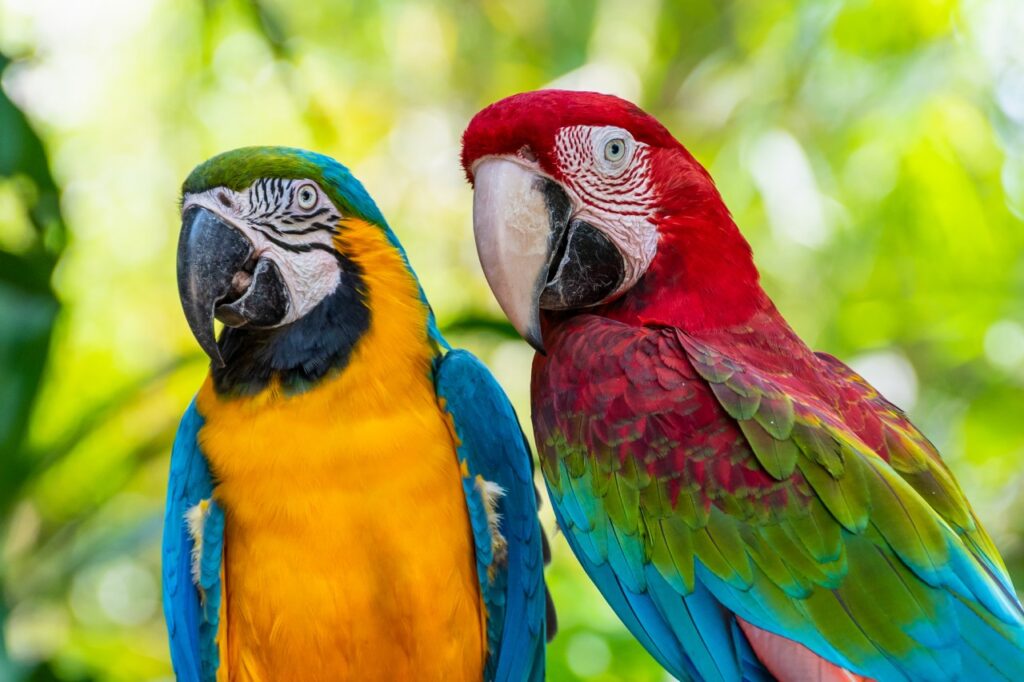
Incidentally, the world is even more colorful for most birds than it is for us, as they have four types of cones and can even see UV light. There are probably evolutionary reasons for this: Some fruits reflect UV light as soon as they are ripe.

How animals really perceive colors, however, remains unclear. Researchers can measure their reaction to color stimuli, but not their perception of color in the brain. Just like the beauty of the world, its colors are in the eyes of the beholder.

Welt der Wunder - Die App

FREE
VIEW